Monday, July 12, 2010

The Flag's Own Right

When the National Flag Conference of 1924 established the rules of flag display, the believed that they were following the rules of heraldry in determining how the flag should be displayed. The upper left of the shield is called the dexter chief, and is the most honorable quarter of the shield. A square portion of the dexter chief is called the canton. In heraldry cantons are often awarded by the monarch as augmentations of honor to commemorate some notable achievement. The committee, therefore, decided that the union of stars would always be displayed in the dexter chief or canton corner of the flag. That is why the union of stars is often called the canton. That is also why the blue starry field is always displayed in the upper left-hand corner when the U.S. flag is hung flat on the wall.

However, the committee allowed one exception to this rule. When the flag is draped on the casket the blue field is placed over the left shoulder of the deceased person. If the rules placing the union in the "canton" corner were applied, the blue field with stars would be placed over the right shoulder.

To explain such inconsistencies, romantic stories often emerge. Two such romantic stories to explain flag draped coffins appeared. First, and most often related, is the explanation given by Colonel James Moss, a respected flag historian: "For generations the customary way of indicating death, the opposite of life, has been to reverse objects." The second story, also described by Moss, "Another explanation—a romantic one—is that the soldier having devoted his life to his Country, the Flag of his country embraces him in death, necessitating the flag facing the soldier which places the blue field to the Flag's right, which is the same as the right of the observer who faces the casket." The second story is harder to understand. Basically, if the flag—as does a person—has a left and right, it has a front side and back side. It the flag is flipped over reversing the position of the canton, then the flag is facing down and symbolically embracing the fallen soldier. Nice stories, but likely an incorrect explanations.

There is another understanding of heraldic rules that was dismissed by the committee. This view is actually the better one. The rules of heraldry were promulgated to facilitate the designing and display of shields and crests. Some rules can be and are applied to the display of flags. Other rules of heraldry do not neatly apply to the design or display of flags. A vexillologist (a student of flag study) could argue that flags should not be viewed as a subsection of heraldry. Heraldry and its rules do not control vexillology.

To begin with, a flag is not a shield. A flag has two sides, a front or obverse and a back or reverse. A shield has a front, but the reverse side carries no design. The back of a shield simply has the straps by which the shield is held and wielded. So, when a shield is displayed, it is never flipped over to show its back.

The U.S. flag has a front and back. Many believe that the front and back of the American flag are the same. Nonetheless they are actually different. The back of the flag is the mirror image of the front. When the flag is displayed on a wall with the stripes running horizontally, we see the front or obverse. When the stripes run vertically, we see the back or reverse of the flag.

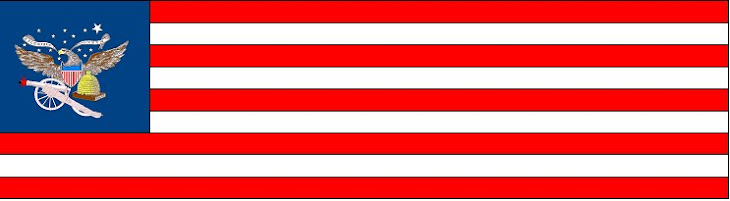
If we stretch the design of the United States flag over a shield (see above) with the stripes running horizontally, the stripes in heraldry are called bars. If we stretch the flag over a shield so that the stripes run vertically, the stripes are then called pallets in heraldic terms. The resulting shields are not identical, but are two similar yet distinct designs. If either shield is rotated to cause the stripes to run another direction, the canton moves from the observer's left (dexter) side to the observer's right (sinister) side.

Had this interpretation of heraldry been adopted, we would simplify things by always displaying the front or obverse of the United States flag. Whenever the flag is rotated to change the direction of the stripes from horizontal to vertical, the union would move from the observer's left to the observer's right. This would have the added advantage that when flags include lettering, such as the with the Utah State flag, they could be displayed uniformly with the U.S. flag without words and designs appearing backwards.

This explains the origin of placing the stars over the deceased left shoulder when the flag is draped on a casket. It is simply done to show the front of the flag. Many draped flags have been banners bearing royal arms or other coats of arms. If the design were flipped to place the dexter chief over the right shoulder of the deceased, the reverse of the flag would be displayed. The design would be backwards. The place where a person stands to view the casket determines how the flag appears. The most important thing is to show the front of the flag.

At the right is a picture of the coffin of Denmark's King Frederick IX. The front the flag is displayed. The same pattern in followed in the United Kingdom. The United States military no doubt followed the European pattern for draping military caskets with flags.

Heraldry and the flag's own right? There is more than one way to look at it. The National Flag Convention of 1924 might not have picked the best interpretation.

Wednesday, June 23, 2010

Mormon Founders of Las Vegas Celebrate the Fourth of July in 1855


Celebrating the Fourth of July in 1855, Mormon founders of Las Vegas' Old Fort raised an improvised flag of Deseret.
Named Las Vegas, meaning the meadows in Spanish, the valley boasted springs which attracted travelers on the Old Spanish Trail. In 1855, Brigham Young sent William Bringhurst and thirty men to establish a way station in the Las Vegas Valley. The area was part of the proposed State of Deseret, but was not included in the Utah Territory established in 1850. Young, however, recognized the strategic importance of Las Vegas as a stopping place between Salt Lake and San Diego.
John Steele recorded in his Journal and in a letter to George A. Smith the 1855 Independence Day celebration at the Old Mormon Fort. "On the Fourth of July" Steele wrote, "we made preparations to celebrate independence, and indeed we did it justice according to our situation." Not having an artillery piece to fire a salute, Steele reported, "the blacksmith's anvil answered for a cannon." The cavity of an anvil was packed with black powder with an inverted anvil placed upon it. The seam was sealed with mud and a fuse leading to the powder lit. The resulting explosion launches the second anvil about on hundred feet into the air. This "shooting off of the anvils" imitated the sound of a firing cannon. This and "many volley of musketry gave the sleeping native to know something was up."
Bringhurst gave Steele 1 ½ yards of white cloth to make a flag. Steele also scrounged a red flannel shirt and some blue denim from an old pair of jeans. Tearing the red and white fabric into stripes, he "took some blue[from the jeans] and made stars." Eighteen small stars were cut in all. They were placed with "nine [stars] on a side [of the flag], with a large eight pointed star in the center representing Deseret." 


This vague description is open to several interpretations. One version has been made up and is on display at the Old Mormon Fort in Las Vegas. A careful reading of the description found in both Steele's journal and letter lead me to a different interpretation of the probable design. My interpretation is also made having had the experience of making several flags with stars and stripes in their design. Neither version is probably completely accurate. We don't know how many red and white stripes were made. The size of the union is unknown. The pattern of the stars is not disclosed. Nevertheless, the stars were most likely blue on a white canton with nine stars and a larger star of Deseret on the front of the flag with the remaining stars on the back of the flag. While this may seem strange to modern eyes, the design is consistent with other flags of Deseret made during the period.
The flag was not ready to be raised at sunrise. Steele completed the flag by early afternoon. Not having "good timber" for a liberty pole, the men "got a mesquite stump, a false wagon tongue, and a tall willow, and made a pole 30 feet high." Here at two o'clock in the afternoon, they "shook out the flag at the sound of guns [and ] three cheers." At the Old Fort's bowery, the men enjoyed "spirited speeches, songs, and toasts…." These pioneers indeed did justice in their celebration of the Fourth.
Today, Las Vegas lies in Nevada, not Utah. Nonetheless, its Flag of Deseret remains an illuminating example in the story of Utah's flags.

Tuesday, June 8, 2010

Folding the United States Flag


  A United States Air Force Honor Guard conducts a flag-folding ceremony at Ramstein Air Base, Germany.
  
We Americans often believe that the traditions we observe in displaying our flag are centuries old and universal. In fact, some rules of flag display only had their origin in the Twentieth Century. Some flag traditions may spring from our history as a nation. Other details of our flag usage have origins obscured by the mist of time. Yet through it all the traditions of flag display continue to grow. Franklin K. Lane, the Interior Secretary expressed it well when he said, speaking for the flag, "I am what you make me; nothing more."
One tradition has grown dramatically in recent times, folding the United States flag. The latest embellishment on the folding ceremony counts the number of folds and gives each fold a symbolic meaning. This adds symbolism to a ceremony that has long been impressive. The United States military makes the folding of burial flags a touching part of funerals. Youth organizations have long taught their members to fold the U.S. flag into a triangle forming a cocked hat shape. Nevertheless, we may wonder where this tradition began.

First of all, folding a flag in a triangular pattern is not a universal flag custom. Other nations have no ceremonial fold for flags. Flags are simply folded in a practical way for storage. Actually, when folding any textiles, the simpler the fold the better. Each fold adds stress to the fibers of the material. For new flags currently in use, the number of folds is not that significant. Conversely, for antique flags the number of folds and their complexity can damage fragile fibers hastening the fabric's deterioration. Museums avoid folding flags for storage whenever they can. Flags, rather, are rolled on acid free cardboard tubes backed with acid free tissue paper and covered with cloth or nonreactive polyethylene plastic.

In fact folding the flag into the triangle is not required by the United States Flag Code. The flag may be folded in any appropriate way. The important thing is to care for and store the United States flag in ways that protect it from becoming damaged or soiled. Folding the flag into a triangle is impressive, but it is not required.

Our folding of the U.S. flag probably began at sea. Flags and ensigns are necessary nautical gear. Ships without flags may be considered pirates. Still, storage space at sea is at a premium. Over the centuries sailors have learned to stow nautical gear efficiently. The saying "a place for everything and everything in its place" had particular meaning at sea. In British naval tradition, the ship's ensign when lowered is brailed. A brail is a rope or line used to furl or gather in a sail. In like manner, a flag is furled by folding it lengthwise several times and then rolling it tightly. The roll is then secured with a brail that has been sewn into the flag's heading. Thus brailed, the ensign is stowed until it is again hoisted. To break out the ensign at hoisting, the brailed flag is attached to the halyards by the rope or line sewn into the flag's heading. Still brailed, it is raised to its full position in the rigging. Then, a tug on the halyard frees the rolled flag and it unfurls dramatically in the wind.

Folding the United States flag in its accustomed triangular fold serves much the same purpose as brailing a flag. The triangular fold produces a neat envelope or packet where the flag is wrapped in itself. When the last flap is folded into the pocket produced by folding, the flag is neat and orderly. It is ready to be "stowed" or stored away until its next use.

How did Americans start folding into a triangle? It is often explained that the triangle symbolizes a three cornered cocked hat as worn during the American Revolution. This is likely a romantic explanation created later. The origin is somewhat obscured by the passage of time. However the custom began, early Americans did not record how they folded the flag and why.

There is one narrative that ties to the story of the historical American flag known as Old Glory. Several versions of the story give slightly different details. However, the substance of the story remains the same.

In 1824 a New England ship's captain prepared to embark on a sea voyage. Several ladies of Salem, his home port, made a ship's ensign for the new captain. His mother was part of the group that presented the flag to William Driver. To consecrate the flag, it was folded into a triangle which represented the Christian Trinity. Narrations explained that his was an "ancient custom of the sea." A minister or priest is said to have blessed the flag in the names of the Trinity intoning each blessing while emphasizing corners of the folded flag. As the clergyman said the words "In the name of the Father," the onlookers responded by chanting the word "glory." The word glory was repeated as the names of the Son and the Holy Ghost were added to the blessing. Then Captain Driver hoisted his new ship's flag and informed the crew "I'll call her old glory, boys, old glory."

Having retired from the sea, Driver moved to Nashville, Tennessee. During the Civil War, he hid the flag from Confederates intent on confiscating and destroying it. When Federal troops captured Nashville, Driver met soldiers from the Ohio 6th Infantry and raised Old Glory over the Tennessee State Capitol. The 6th Ohio adopted the motto "Old Glory" as its own. Apparently, Driver gave the regiment a smaller U.S. flag. Did he fold the gift flag in a triangle that was copied by the soldiers for folding other U.S. flags? That is possible, though certainly not documented.

United States Military Regulations of the Nineteenth Century do not mention folding the flag. Even current regulations mention it mainly as a part of funeral ceremonies. How to fold the United States flag is more important to us today than it was in the past.

Narrations have been written giving symbolic interpretation for each fold that is made when folding the United States flag. These can add new meaning to the ceremony as the flag is folded. This will not be the last change to our flag customs. They continue to evolve to reflect the ideals that we find important. They give new meaning to our flag. The Flag of the United States of America is what we make it. It has the meaning we give it. The flag and its meaning will grow as does our nation.

Thursday, June 3, 2010

U.S. Flag in the Twentieth Century


The Twentieth Century saw the number of U.S. States increase from forty-five to fifty. Five flags mirrored that growth. An increase from forty-five to forty-six in 1908 for Oklahoma; a jump from forty-six to forty-eight for New Mexico & Arizona in 1912; Alaska made forty-nine in 1959; and finally, in 1960, Hawaii brought the total to fifty. There it has remained for fifty years. Only the forty-eight star flag, with 47 years, approaches the longevity of the fifty star flag.

The common pattern of stars and stripes has existed since the American Revolution. But the admission of new states has hardly been smooth or predictable. For most of the flag's history, the pattern of stars has been anything but "regulation." Sometimes the Army and the Navy had different versions of the flag. During the Civil War, the white stars even turned gold on Army National Colors. Silver paint oxidized and turned the stars black. For that reason gold paint, which does not oxidize, was substituted. Cavalry standards of the era even cut a "v" from the stripes to form a swallow tale flag. American flags were anything but uniform.

The regularity we take for granted did not come into being until 1912. President William Howard Taft appointed a blue ribbon, or perhaps better described, a red, white and blue committee. Spanish American War hero, Admiral George Dewey, served as chairman. Very much like a military formation, the stars were arranged in six even rows of eight stars each. Looking at that pattern of stars, one can almost hear the military order, "Dress and Cover!" For those who have not enjoyed the privilege of standing a military formation. The stars in the forty-eight star flag lined up evenly horizontally and vertically, not in staggered rows as we have known before and since. Nevertheless, the real innovation of 1912 came with the establishment of ratios for all the elements of the United States flag: the ratio of length to width, the ratio of the dimension of the blue union to the whole. Even the stars were assigned a ration of 0.0616 of the hoist. Why 0.0616 and not 0.0615? I envisioned President Taft sitting up in the Lincoln bed with a yellow legal pad and a slide rule working it out. Actually, 0.0616 is the decimal version of the relation of the diameter of the stars to the width of the stripes. A stripe is ⅟13th of the width of the flag or 0.0769 which rounds off to 0.077. The stars are ⅘th or 0.8 of the width of the stripes. The decimal number 0.077 time 0.8 equals 0.0616. I don't know who figured that one out; probably not President Taft. Nevertheless, it was President Taft who made it all official. He made the forty-eight star flag official by Presidential Proclamation. That is the pattern that has been followed by succeeding presidents when new stars have been added to the flag.

Are the stars actually that exact ratio? Well, not exactly. The stars on U.S. flags used to be appliquéd on the blue field. Considering the number of stars front and back, that becomes a tedious and expensive process. Fifty stars on the front and fifty stars on the back for one hundred stars on each flag. Flag makers have learned tricks to make producing starry unions easier. Nonetheless only stars on large flags are appliquéd in place today. Most flag have printed or embroidered stars. The beautiful embroidered stars look elaborate. Many people assume they are costly to make. Yet they are actually embroidered by sophisticated machines that produce starry field rapidly. While the machines are expensive, once purchased they produce large numbers of star spangled unions that are much more cost effective that appliquéd ones would be. Still, they can only produce stars of a few standard sizes. Flag makers get as close to the 0.0616 as possible. Even President Taft and Admiral Dewey would agree that these flags are beautiful.

Figuring the dimensions of the United States flag using the proportions scaled using the ratios based on the hoist or with is nonetheless awkward. Basing the ratio on the width of the stripe actually makes the task of constructing the flag easier. It is logical that if the width of the stripe is defined as one, the width of the flag is thence thirteen. Converting the rest of the ratios established in 1912, we find that the length of the flag is 24.7 which rounds to 25 units equal to the width of the stripe. The diameter of the star is no longer the complex 0.0616 ordained in 1912; it is now simply four fifths or eight tenths of the width of the stripes. See the diagram shown below to find the ration of the flag's elements in ratio to the width of the stripes. Flags of different sizes can be easily drawn, painted or sewn.

How do we make a five pointed star? Heavens to Betsy. The story of Samuel Wetherill, his safe and Betsy Ross' star is one that is seldom told. Well, that's another story for another time. 


Thursday, May 27, 2010

Is it Half-Staff or Half-Mast?


This picture of the Memorial honoring the USS Arizona raises an interesting question. Is the flag shown in the photograph flying at half-mast or half-staff? Strange as it may seem, the concepts behind the question are sometimes hotly debated. The simple answer, though not accepted by all, is that a flag or ensign flown from a ship's rigging is placed a half-mast; a flag flown on land from a flag pole is placed at half-staff. In the cast of the Arizona, the flagstaff seen in the picture is attached to the severed mainmast. When the Arizona was yet in commission, she would have flown her ensign not from the mainmast but from a spar or gaff at her stern. She is not in commission now, but a U.S. Navy color guard raises and lowers the flag daily. However, to avoid injuring the sensitivities of any sailors who may read this blog, let's concede that the Stars and Stripes flying over the USS Arizona flies at half-mast. That seems only appropriate.

The custom of showing mourning by displaying a flag raised below its highest position, began at sea. It appears to go back at least to the sixteenth century, but its source is uncertain. It is often asserted that the lowered flag leaves a vacant space for "deaths invisible flag." This is a romantic notion likely invented to explain a tradition already long established. It is doubtful that superstitious sailors would want death's flag, invisible or not, flying over their ship. One author reports that flying a flag at half-mast replaced another custom. "Yards were once 'cockbilled,' and rigging was slacked off as a sign of mourning" (Page 48, Naval Customs, Traditions, and Usage, Lieutenant Commander Leland P. Lovette, U.S. Navy, United States Naval Institute: Annapolis, Maryland, 1939). Those nautical terms are difficult for the landlubber to comprehend. The illustration below shows a mast with cockbilled yards. Lovette goes on to explain that "The half-masting of colors is in reality a survival of days when a slovenly appearance characterized mourning."

In 1826 John Adams and Thomas Jefferson both died on the same day, July Fourth. When word reached the USS Constitution, the battleship honored the former presidents by half-masting its ensign, firing gun salutes, and cockbilling its yards (Journal of George Jones quoted by Lovette). Over the years, only flying a flag at half-mast has survived as a sign of mourning. No doubt sailors were not happy to see their vessel not in proper order.

The practice of flying a flag at half-mast spread to land. The terminology evolved from half-mast to half-staff. Adherents of the term half-mast point out that the dictionary entry for half-staff refer the reader to half-mast. Half-staff is, after all, the original term. However, the U.S. Flag Code exclusively uses the term half-staff. Still, the Flag Code only addresses display of flags on land. It seems logical and appropriate that a flag is half-masted when flown from a mast and half-staffed when flown from a flagstaff.

Why is the flag raised to full-staff before lowering it to the half-staff position? Why must it be raised to full-staff before it is lowered? The full-staff position is the "saluting point." It is raised there to honor the flag, which symbolizes the whole nation. The flag then is lowered to half-staff as a sign of mourning. At days end, it is again raised to full- staff to again salute the flag, and then it is lowered.

What is the position of half-staff? Must it be the actual half way point? Here common sense is the rule. The flag is lowered to the position that fits its surroundings. By American usage, any position below full-staff is considered to be half-staff. Tree branches, bushes or buildings may dictate the position of the flag when flown at half-staff. It must not touch or be entangled in anything below it. Conversely, it needs to fly low enough that it does not appear to be positioned there by mistake.

Must the flag be raised to full staff exactly at noon? Again logic should rule. The day's events may dictate a time before or after the stroke of twelve. Nevertheless, it is better for a flag to be raised to full staff at eleven o'clock in the morning than to remain at half-staff at four in the afternoon.

We pay attention to the details so that our sign of mourning will not be appear to be "cockbilled" or sloppy. Nonetheless, most observers will not notice many of these details. We show we care by doing it correctly. The important thing is to honor our dead appropriately, that their service and sacrifice will not be forgotten.

Visit flag-post.com for more about displaying the flag on Memorial Day.

Monday, May 17, 2010

Norway’s Constitution Day and the Clean Flag

At the beginning of the Nineteenth Century, Norway was united with Denmark.  Having been allied with France, Denmark found itself in the loser's column at the end of the Napoleonic Wars.  As a result, the Congress of Vienna conveyed Norway from Denmark to Sweden.  The Norwegians, unhappy with the arrangement, declared their independence on May 17th 1814 and produced a constitution for their new nation.  The king of Sweden invaded Norway and after a short war the parties signed the ceasefire of Moss on August 14th of the same year.  The Swedes, by this agreement, recognized Norway's Independence, its constitution and its borders.  In return, the Norwegians accepted the personal union of the two nations under the Swedish king.  Each had a separate democratic parliament.  However, the king often sided with his Swedish ministers against the Norwegian desires and interests.  One major issue that caused friction between the king's two realms centered on the display of flags.  The king wanted his two kingdoms to display a common flag.  The common flag favored by the king was the Swedish flag with the addition of an "X" shaped cross on a red background in the upper portion of the flag close to the flagstaff.  The Norwegians, however, wanted their own flag.  They had a historical attachment to the Danish flag, but the Swedish flag reminded them the union the Norwegians did not choose.

In 1814 the Norwegians chose a flag of their own.   They added the emblem from the Norway's coat of arms to the Danish flag.  The lion of Saint Olaf with a battle-axe appeared in the upper corner of the flag next to the flagstaff.  The king allowed the flag's use in northern waters, but required that the union flag be flown in other international waters.

In 1821 Norway adopted a new flag that was once again based on the Danish flag.  The Norwegians added a narrow blue cross in the center of the white Nordic cross found on the Danish flag.  Again, the king only allowed merchant ships to display the flag in northern waters.  In other international waters, a new union flag would be used.  It added a new union design in the canton corner of the Norwegian flag.  Swedish merchant ships would fly the Swedish flag with the same union device added to that flag. The Norwegians disliked the new union emblem.  It was formed by taking two horizontal wedges from the Swedish flag and combining them with two vertical wedges from the new Norwegian flag.  The Norwegians said the complicated union device looked like a "herring salad."  The wanted to display their own "clean" flag at home and abroad.

The king opposed any change to the flags.  However, in 1898 the Storting (Norway's parliament) adopted the clean flag as Norway's only flag.  The king also refused to accept other acts of the Norwegian parliament.  The Storting then declared that the king had abdicated and that the Norwegian throne was vacant.  Prince Carl of Denmark accepted the Norwegian crown in 1905.  He ascended the throne as King Haakon VII.

Today, the Norwegians display their "clean flag" proudly.  Especially on the anniversary of their constitution, Norwegians carry their beloved flag in huge public parades.

Thursday, May 6, 2010

The Flag Over Disneyland's Town Square

 Flags abound at Disneyland.  Over the years flags have flown all over the park, all kinds of flags.  Prominent among them all is the Stars and Stripes.  The U.S. flag flies over the Main Street Train Station and also over Disneyland’s City Hall.  Walt reserved a special place of honor at the center of Town Square for Disneyland’s main flagpole.  Beginning on opening day, the Town Square flagpole has been the site of uncounted flag ceremonies.  It may, therefore, be surprising to discover that that a bandstand was originally planned for the spot.  A bandstand at the center of the Town Square?  What could be more appropriate?  Through the years the Disneyland Band has performed daily concerts at Town Square.    A bandstand could only enhance the band concerts.  So, what happened to the bandstand?  How is it that it was replaced by the flag pole?
During construction, workers built a magnificent bandstand and placed it on the exact spot where the flagpole now stands.  When Walt stood on the steps of the Railroad Station, the bandstand blocked the view of Main Street and Sleeping Beauty Castle.  As much as Walt wanted a bandstand, he recognized the greater importance of an unobstructed view.  He had planned Sleeping Beauty Castle as a “weenie.”  To work, a “weenie” must be visible.  For those unfamiliar with this term in “Disneyspeak,” we had better define the term.  In this special Disneyland vocabulary, the word means a visual prompt that attracts people from one location to another.  Walt explained it as follows:
What you need is a weenie, which says to people 'come this way.'   People won't go down a long corridor unless there's something promising at the end. You have to have something the beckons them to 'walk this way.'
Walt planned Sleeping Beauty Castle as a visual magnet to draw guest along Main Street to the Plaza.  If guests could not see the Castle, they would not hurry to the Plaza to start their adventures at Disneyland.  Yes, the bandstand had to go.  It was moved away.  What to put in its place?  An imagineer (Disneyspeak for a Park planner) passed an automobile accident on Wilshire Boulevard.  A car had knocked down a lamppost with a decorative base.  Disney purchased the base for five dollars, a paltry sum, even in 1954.  It was installed at Town Square as the base of a flagpole.  During the opening day ceremony for Disneyland, Walt read a specially written dedication for the Park.  Then the Governor of California, Goodwin Knight dedicated the flag.   His speech appeared to please Disney, but then what do you say to the Governor.  Today, Knight’s words ring a little jingoistic.
                                                                                               
And as we dedicate the flag now we do it with the knowledge that we are the fortunate ones to be Americans and that we extend to everyone everywhere the great ideals of Americanism, brotherhood, and peace on earth goodwill towards all men.

Service men from all four military services then raised the flag over the Square.  Today, Goodwin Knight’s words are almost forgotten.  However, Disney’s words of dedication for Disneyland are recorded on a plaque at the base of the flagpole:

To all who come to this happy place... Welcome. Disneyland is your land.
Here age relives fond memories of the past... and here youth may savor
the challenge and promise of the future.
Disneyland is dedicated to the ideals, the dreams, and the hard facts
that have created America... with the hope that it will be a source of joy and inspiration to all the world.

Disney honored the nation by placing a flagpole prominently at Town Square.  He honored the nation daily with flag ceremonies.  It was appropriate then that the nation honored Walt at Town Square’s flagpole.  Late in the morning of December 15th in 1966, somber cast members (Disneyspeak for employees) lowered the flag to half staff.  Walt Disney had died earlier that morning.  Cast members and guests joined in mourning the man who created Disneyland.
            Since opening day fifty-five years ago, there have been daily flag ceremonies at the flagpole.  Not to raise the flag.  The United States flag is raised each day well before the Park opens.  However, each afternoon the flag is lowered with appropriate honors.  The Disneyland Band often plays.  Guest bands sometime provide the patriotic music. Bandstand or no bandstand, the bands are as much a part of Town Square as the flag pole itself with the five dollar ornamental lamppost base.  It was important to Walt that the nation be appropriately honored.  Disneyland is indeed “dedicated to the ideals, the dreams, and the hard facts that have created America.”

Ceremony lowering the Flag with a Disneyland High School All-Star Band.