Thursday, May 27, 2010

Is it Half-Staff or Half-Mast?


This picture of the Memorial honoring the USS Arizona raises an interesting question. Is the flag shown in the photograph flying at half-mast or half-staff? Strange as it may seem, the concepts behind the question are sometimes hotly debated. The simple answer, though not accepted by all, is that a flag or ensign flown from a ship's rigging is placed a half-mast; a flag flown on land from a flag pole is placed at half-staff. In the cast of the Arizona, the flagstaff seen in the picture is attached to the severed mainmast. When the Arizona was yet in commission, she would have flown her ensign not from the mainmast but from a spar or gaff at her stern. She is not in commission now, but a U.S. Navy color guard raises and lowers the flag daily. However, to avoid injuring the sensitivities of any sailors who may read this blog, let's concede that the Stars and Stripes flying over the USS Arizona flies at half-mast. That seems only appropriate.

The custom of showing mourning by displaying a flag raised below its highest position, began at sea. It appears to go back at least to the sixteenth century, but its source is uncertain. It is often asserted that the lowered flag leaves a vacant space for "deaths invisible flag." This is a romantic notion likely invented to explain a tradition already long established. It is doubtful that superstitious sailors would want death's flag, invisible or not, flying over their ship. One author reports that flying a flag at half-mast replaced another custom. "Yards were once 'cockbilled,' and rigging was slacked off as a sign of mourning" (Page 48, Naval Customs, Traditions, and Usage, Lieutenant Commander Leland P. Lovette, U.S. Navy, United States Naval Institute: Annapolis, Maryland, 1939). Those nautical terms are difficult for the landlubber to comprehend. The illustration below shows a mast with cockbilled yards. Lovette goes on to explain that "The half-masting of colors is in reality a survival of days when a slovenly appearance characterized mourning."

In 1826 John Adams and Thomas Jefferson both died on the same day, July Fourth. When word reached the USS Constitution, the battleship honored the former presidents by half-masting its ensign, firing gun salutes, and cockbilling its yards (Journal of George Jones quoted by Lovette). Over the years, only flying a flag at half-mast has survived as a sign of mourning. No doubt sailors were not happy to see their vessel not in proper order.

The practice of flying a flag at half-mast spread to land. The terminology evolved from half-mast to half-staff. Adherents of the term half-mast point out that the dictionary entry for half-staff refer the reader to half-mast. Half-staff is, after all, the original term. However, the U.S. Flag Code exclusively uses the term half-staff. Still, the Flag Code only addresses display of flags on land. It seems logical and appropriate that a flag is half-masted when flown from a mast and half-staffed when flown from a flagstaff.

Why is the flag raised to full-staff before lowering it to the half-staff position? Why must it be raised to full-staff before it is lowered? The full-staff position is the "saluting point." It is raised there to honor the flag, which symbolizes the whole nation. The flag then is lowered to half-staff as a sign of mourning. At days end, it is again raised to full- staff to again salute the flag, and then it is lowered.

What is the position of half-staff? Must it be the actual half way point? Here common sense is the rule. The flag is lowered to the position that fits its surroundings. By American usage, any position below full-staff is considered to be half-staff. Tree branches, bushes or buildings may dictate the position of the flag when flown at half-staff. It must not touch or be entangled in anything below it. Conversely, it needs to fly low enough that it does not appear to be positioned there by mistake.

Must the flag be raised to full staff exactly at noon? Again logic should rule. The day's events may dictate a time before or after the stroke of twelve. Nevertheless, it is better for a flag to be raised to full staff at eleven o'clock in the morning than to remain at half-staff at four in the afternoon.

We pay attention to the details so that our sign of mourning will not be appear to be "cockbilled" or sloppy. Nonetheless, most observers will not notice many of these details. We show we care by doing it correctly. The important thing is to honor our dead appropriately, that their service and sacrifice will not be forgotten.

Visit flag-post.com for more about displaying the flag on Memorial Day.

Monday, May 17, 2010

Norway’s Constitution Day and the Clean Flag

At the beginning of the Nineteenth Century, Norway was united with Denmark.  Having been allied with France, Denmark found itself in the loser's column at the end of the Napoleonic Wars.  As a result, the Congress of Vienna conveyed Norway from Denmark to Sweden.  The Norwegians, unhappy with the arrangement, declared their independence on May 17th 1814 and produced a constitution for their new nation.  The king of Sweden invaded Norway and after a short war the parties signed the ceasefire of Moss on August 14th of the same year.  The Swedes, by this agreement, recognized Norway's Independence, its constitution and its borders.  In return, the Norwegians accepted the personal union of the two nations under the Swedish king.  Each had a separate democratic parliament.  However, the king often sided with his Swedish ministers against the Norwegian desires and interests.  One major issue that caused friction between the king's two realms centered on the display of flags.  The king wanted his two kingdoms to display a common flag.  The common flag favored by the king was the Swedish flag with the addition of an "X" shaped cross on a red background in the upper portion of the flag close to the flagstaff.  The Norwegians, however, wanted their own flag.  They had a historical attachment to the Danish flag, but the Swedish flag reminded them the union the Norwegians did not choose.

In 1814 the Norwegians chose a flag of their own.   They added the emblem from the Norway's coat of arms to the Danish flag.  The lion of Saint Olaf with a battle-axe appeared in the upper corner of the flag next to the flagstaff.  The king allowed the flag's use in northern waters, but required that the union flag be flown in other international waters.

In 1821 Norway adopted a new flag that was once again based on the Danish flag.  The Norwegians added a narrow blue cross in the center of the white Nordic cross found on the Danish flag.  Again, the king only allowed merchant ships to display the flag in northern waters.  In other international waters, a new union flag would be used.  It added a new union design in the canton corner of the Norwegian flag.  Swedish merchant ships would fly the Swedish flag with the same union device added to that flag. The Norwegians disliked the new union emblem.  It was formed by taking two horizontal wedges from the Swedish flag and combining them with two vertical wedges from the new Norwegian flag.  The Norwegians said the complicated union device looked like a "herring salad."  The wanted to display their own "clean" flag at home and abroad.

The king opposed any change to the flags.  However, in 1898 the Storting (Norway's parliament) adopted the clean flag as Norway's only flag.  The king also refused to accept other acts of the Norwegian parliament.  The Storting then declared that the king had abdicated and that the Norwegian throne was vacant.  Prince Carl of Denmark accepted the Norwegian crown in 1905.  He ascended the throne as King Haakon VII.

Today, the Norwegians display their "clean flag" proudly.  Especially on the anniversary of their constitution, Norwegians carry their beloved flag in huge public parades.

Thursday, May 6, 2010

The Flag Over Disneyland's Town Square

 Flags abound at Disneyland.  Over the years flags have flown all over the park, all kinds of flags.  Prominent among them all is the Stars and Stripes.  The U.S. flag flies over the Main Street Train Station and also over Disneyland’s City Hall.  Walt reserved a special place of honor at the center of Town Square for Disneyland’s main flagpole.  Beginning on opening day, the Town Square flagpole has been the site of uncounted flag ceremonies.  It may, therefore, be surprising to discover that that a bandstand was originally planned for the spot.  A bandstand at the center of the Town Square?  What could be more appropriate?  Through the years the Disneyland Band has performed daily concerts at Town Square.    A bandstand could only enhance the band concerts.  So, what happened to the bandstand?  How is it that it was replaced by the flag pole?
During construction, workers built a magnificent bandstand and placed it on the exact spot where the flagpole now stands.  When Walt stood on the steps of the Railroad Station, the bandstand blocked the view of Main Street and Sleeping Beauty Castle.  As much as Walt wanted a bandstand, he recognized the greater importance of an unobstructed view.  He had planned Sleeping Beauty Castle as a “weenie.”  To work, a “weenie” must be visible.  For those unfamiliar with this term in “Disneyspeak,” we had better define the term.  In this special Disneyland vocabulary, the word means a visual prompt that attracts people from one location to another.  Walt explained it as follows:
What you need is a weenie, which says to people 'come this way.'   People won't go down a long corridor unless there's something promising at the end. You have to have something the beckons them to 'walk this way.'
Walt planned Sleeping Beauty Castle as a visual magnet to draw guest along Main Street to the Plaza.  If guests could not see the Castle, they would not hurry to the Plaza to start their adventures at Disneyland.  Yes, the bandstand had to go.  It was moved away.  What to put in its place?  An imagineer (Disneyspeak for a Park planner) passed an automobile accident on Wilshire Boulevard.  A car had knocked down a lamppost with a decorative base.  Disney purchased the base for five dollars, a paltry sum, even in 1954.  It was installed at Town Square as the base of a flagpole.  During the opening day ceremony for Disneyland, Walt read a specially written dedication for the Park.  Then the Governor of California, Goodwin Knight dedicated the flag.   His speech appeared to please Disney, but then what do you say to the Governor.  Today, Knight’s words ring a little jingoistic.
                                                                                               
And as we dedicate the flag now we do it with the knowledge that we are the fortunate ones to be Americans and that we extend to everyone everywhere the great ideals of Americanism, brotherhood, and peace on earth goodwill towards all men.

Service men from all four military services then raised the flag over the Square.  Today, Goodwin Knight’s words are almost forgotten.  However, Disney’s words of dedication for Disneyland are recorded on a plaque at the base of the flagpole:

To all who come to this happy place... Welcome. Disneyland is your land.
Here age relives fond memories of the past... and here youth may savor
the challenge and promise of the future.
Disneyland is dedicated to the ideals, the dreams, and the hard facts
that have created America... with the hope that it will be a source of joy and inspiration to all the world.

Disney honored the nation by placing a flagpole prominently at Town Square.  He honored the nation daily with flag ceremonies.  It was appropriate then that the nation honored Walt at Town Square’s flagpole.  Late in the morning of December 15th in 1966, somber cast members (Disneyspeak for employees) lowered the flag to half staff.  Walt Disney had died earlier that morning.  Cast members and guests joined in mourning the man who created Disneyland.
            Since opening day fifty-five years ago, there have been daily flag ceremonies at the flagpole.  Not to raise the flag.  The United States flag is raised each day well before the Park opens.  However, each afternoon the flag is lowered with appropriate honors.  The Disneyland Band often plays.  Guest bands sometime provide the patriotic music. Bandstand or no bandstand, the bands are as much a part of Town Square as the flag pole itself with the five dollar ornamental lamppost base.  It was important to Walt that the nation be appropriately honored.  Disneyland is indeed “dedicated to the ideals, the dreams, and the hard facts that have created America.”

Ceremony lowering the Flag with a Disneyland High School All-Star Band.

Thursday, April 22, 2010


John C. Frémont’s Pathfinder Flag

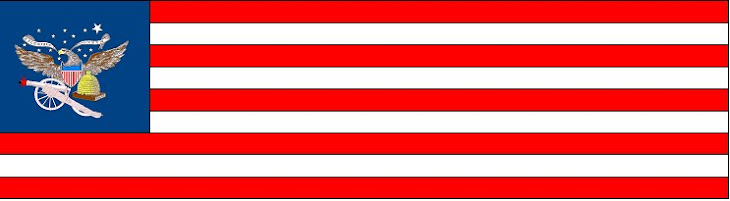
Published flag histories often include information that has not been produced by careful and thorough research. Various errors originated with histories written many years ago. Writers of more recent books and articles have often accepted far too much from these earlier flag histories without researching the original sources. The flag of John C. Frémont is one flag that has not received the careful research it deserves. Sometimes called the pathfinder flag, this is an interesting and unique flag of American history.
More often than not, illustrations portraying this flag are grossly inaccurate. Details written about the flag’s design are not only often wrong, but they fail to tell the real story which is even more interesting than incorrect information usually related. Finally, most histories assert that Frémont carried his flag on all of his expeditions to the West. This claim is far from certain.
Since Stars and Stripes almost always have blue cantons with white stars, the Frémont flag is usually shown following that pattern. Even when the canton is shown white, the stars are often shown as blue stars on a white background. However, the original flag is in the collection of Los Angeles’ Southwest Museum. It has a white canton with white stars that are outlined in blue.
A flag history written in 1964 states, “At the time a personalized Stars and Stripes was not illegal—merely distasteful.” Another flag history, published in 2002 maintains that, “Because Fremont was on a topographical expedition into areas claimed by Mexico, he chose not to carry a regular U.S. flag.” Actually, Stars and Stripes that included the American eagle amid the stars of the union were not at all uncommon in the nineteenth century. The “Indian Department” which at the time was part of the War Department provided flags to Native Americans that included eagles in their cantons. Lewis and Clark presented similar flags to native tribes during their expedition to the Northwest. Trappers and traders also used trade flags displaying eagles in their unions. The Frémont flag is unique only it its depiction of a peace pipe in place of the usual olive branch. The flag is also unusual in its use of a white canton and blue outlined white stars. However, an eagle was not unusual in the flag of an explorer of the American West.
What then is the actual story of the Frémont flag? While we are not sure of all the details, we do know the a great deal about the history of this famous flag. In 1838 John Charles Frémont received a U.S. Army commission as a second lieutenant in the newly formed Corps of Topographical Engineers. The corps had the charge of mapping unknown territories of the United States. He learned mapping from Joseph Nicollet in an expedition to the upper Mississippi in 1838 to 1839. After marrying Jesse Benton, daughter of Senator Thomas Hart Benton in 1841, Frémont let his first expedition to the Rocky Mountains. Senator Benton encouraged his son-in-law to apply to the Secretary of War for funds to purchase presents, which would presumably include flags, for presentation to indigenous people. Benton noted, “. . . it is indispensable that the officer who carries the flag of the U. States into these remote regions, should carry presents. All savages expect them; they may even demand them; and feel contempt & resentment if disappointed.” Military requisitions show that Frémont obtained glass beads, fishhooks and flags for his expeditions. Frémont, in a report for one the expeditions, described a meeting with Native Americans. “Having made the customary and expected presents which ratified the covenants of good will and free passage over their country,” he noted “we left the village, escorted by their chiefs.” The ratification of “the covenant of good will” with native tribes usually involved the presentation of a U.S. flag provided by the Indian Department. We can see that Frémont, as an officer of the Topographical Engineers almost certainly carried the U. S. flag on his expeditions.
Frémont‘s Pathfinder flag was made by Jessie Benton Frémont for her husband’s first expedition to the Rocky Mountains. She followed the basic pattern of the flags provided by the Indian Department. The bunting stripes of the flags fields may have come from a purchased U.S. flag with Jessie replacing the usual starry union with a piece of white linen. On the white fabric, she painted twenty six white stars outlined in blue. Between the two undulating rows of stars, she painted an eagle holding arrows in the right talons and a calumet or peace pipe in the left talons. This was this flag that Frémont raised on the highest peak of the Wind River chain of mountain in what is now Wyoming. Understandably, he did not present this flag to any native tribes, but kept is as a prized souvenir. Returning to the East, Frémont presented the memento back to his wife upon the birth of their daughter Elizabeth. Whereupon, Jessie Frémont backed the flag with a piece of lilac silk cut from her wedding gown. She embroidered the words “Rocky Mountains” with the year “1841” on the silk backing. As a final decoration, she also embroidered a butterfly on the silk cloth. There is no record that Frémont ever carried that flag to the West again. However, it is hard to prove the negative. It is possible that he carried the flag on a subsequent trip west, and that the fact was not recorded. Still, one would wonder why other years were then not added to the embroidery to commemorate other expedition where the flag would have been flown. Also, the embroidered silk fabric hardly seems appropriate material to be carried on the arduous trips that the subsequent expeditions certainly were. At any rate, the flag was inherited by Elizabeth Frémont, Jessie and John’s daughter. Early in the twentieth century, she donated the prized artifact to the Southwest Museum, where it remains today. The acquisition record of the Southwest Museum for the flag note the following: “It is unknown if this is the flag Fremont flew in California.” It is likewise unknown if Frémont ever flew this flag in Utah. The record of Frémont’s expedition to Utah records one instance where he met an important Ute leader, Chief Walkara, known to the whites as Chief Walker. Frémont recorded: “He [Walkara] knew of my expedition of 1842; and, as a token of friendship, and proof that we had met, proposed an exchange of presents. We had no great store to choose out of; so he gave me a Mexican blanket, and I gave him a very fine one which I had obtained in Vancouver.” This would have been an excellent time to present a flag as a token of “the covenant of good will.” However, apparently Frémont had already depleted his store of gifts, if he brought any with him on his trip to the Great Basin. Still, as a U.S. Army officer, he would have carried the flag of the United States.
Sunday, March 28, 2010

George Washington and the United States Flags

We recognize George Washington as a central figure in the struggle for American independence and the founding of United States. Washington’s contributions more that justify this judgment. Likely for this reason, histories of the United States flag have endeavored to chronicle Washington’s part in the flag’s history. Unfortunately, the historical record is sketchy and incomplete. Still, Washington’s influence is there when we consider his role of the Commander-in-chief of the Continental Army.
To understand Washington and the history of the U.S. flag, we must consider the role of flags in eighteenth century warfare. In the twenty-first century flags, fifes, drums and uniforms play a ceremonial role in parades and pageantry. However, in the eighteenth century these items of military gear were essential equipment for an army.
Washington received his military training as an officer in the Virginia Militia during the French and Indian War. The British used a system of two military flags: a Kings Color and a Regimental Color. The placement of these two flags or colors determined each soldier’s position in his regiment’s formation. In the din of battle, the placement of these flags and the music of the fife and drums, communicated the orders of battle drill. A regiment’s colors helped establish military discipline in the field and in battle.
New England militia did not prevail against a larger, better supplied British force at Bunker Hill. However, they did exact huge casualties upon the British army. They demonstrated that American colonists could fight the troops of Great Britain. In Philadelphia, Washington wore his militia uniform when Congress met. His stature and reputation influenced Congress to create a Continental Army with Washington as Commander-in-chief. Traveling to the militia encampment in Cambridge, Washington found willing soldiers. Although they were accomplished marksmen, they lacked military training and discipline that their new commander deemed essential. In the General Orders he issued on first day of January in 1776, Washington observed, “that an Army without Order, Regularity and Discipline, is no better than a Commission'd Mob . . . .” For Washington, a military force without appropriate flags, fife, drums and uniforms, was a “Commission’d Mob” and not an army. To win respect of the British forces, American colonists needed not only to prevail in battle, they needed to present themselves as “an Army . . . [with] Order, Regularity and Discipline. . . .” To achieve this, they needed appropriate military equipment, including appropriate flags. In place of a King’s Color, the colonists would have used a flag to symbolize their union. This union flag is called the National Color.
Washington’s staff corresponded with the Continental Congress repeatedly in the effort to obtain the needed flags. Congress failed to fill the requisitions for colors. Washington was determined to lead a disciplined army not a commissioned mob. A disciplined army needed appropriate military equipment, including flags.
The invasion of British troops forced the evacuation of New York. The necessities for boots, clothing, provisions and shelter pushed the need for flags into the background. Still, Washington continued in his efforts to turn the “Commission’d Mob” into a disciplined Army. Von Steuben drilled a ragged force at Valley Forge. Von Steuben’s drill manual includes diagrams of troop formations showing the placement of colors. The position of colors is included as part of the drill instructions. Over the period of the war, some regiments obtained military flags. Others made due with locally made flags. Washington built his disciplined army as he fought the War of Independence. He never received from Congress all the flags he wanted. Still when Cornwallis’ army surrendered at Yorktown, the American army carried U.S. National Colors and Regimental Colors with pride. Washington and his American army had bested the well trained, experienced and disciplined troops of the British Empire. With flags flying, Washington led his “…Army . . . [with] Order, Regularity and Discipline. . . ” to victory.

Thursday, March 25, 2010

A New Constellation

Today’s U.S. flag boasts a union with fifty stars, one for each of our fifty states. What then did the thirteen white stars in the blue union of our first flag represent? The thirteen original colonies? Yes, that is true in a general sense. However, in a more specific sense, the thirteen stars actually represented not thirteen colonies, but a new constellation. The wording of the first flag resolution adopted on June 14th in 1777 reads exactly: “Resolved that the Flag of the united states be 13 stripes alternate red and white, that the union be 13 starts white in a blue field representing a new constellation.”
We understand a stripe and a star for each of the thirteen original colonies that formed the thirteen United States. However, what did the members of the Continental Congress mean by “a new constellation?” To understand that, we need to forget our twenty-first century interpretation. The symbol of a new constellation is an eighteenth century concept that fit the context of the time when American patriots declared their independence from the British Empire. After two and one third centuries of independence, we fail to understand the original meaning of the flag resolution and the “new constellation.”
Stars are now common symbols found on many flags. This was not the case in the 1770s. The introduction of stars on flags reflected ideas and concepts that were then new.
Modern astronomy emphasizes the science of light harnessed by giant telescopes. It is a discipline of rockets, satellites and scientific observation. Astronomy in the eighteenth century was a study of celestial maps and spheres locating named stars and constellations. A well equipped classroom of the seventeen hundreds included a terrestrial globe showing colonies, nations and empires. An accompanying celestial globe in similar fashion displayed planets, stars and constellations. Similarly, terrestrial and celestial maps and charts depicted the same details. Eighteenth century students understood that each night constellations rose in the sky taking their places among the other groupings of stars in the firmament. In this setting the stars and constellations of the heavens came to symbolize the nations and empires of the earth. Thirteen former British colonies jointed together to form a new empire that would rise like a new constellation and takes its place among the empires of the earth.
The first mention of a star on an American flag came three years before the flag resolution of 1777. On the 10th of March in 1744, The Massachusetts Spy published a verse entitled “Song for the 5th of March.” This was in remembrance of the Boston Massacre’s fourth anniversary . The seventh verse of the song reads: "A Ray of bright glory now Beams from afar, Bless’t dawn of an Empire to rise; The American Ensign now sparkles a Star, Which shall shortly flame wide through the skies." We don’t know what flag or “American Ensign” bore a star in 1774. But the symbolism is stated clearly. The star stands for the dawn of a rising Empire. What empire? An American ensign would logically represent an American empire.
The flag resolution of 1777 gives the phrase “a new constellation” in a matter of fact wording with no explanation. It appears that the Congress expected readers would understand the intended meaning and symbolism. Five years later in 1782, congress adopted the Great Seal of the United States. It included a crest showing a cluster of stars described as a “new constellation.” Charles Thompson, the secretary of Congress provided “notes and explanations” to detail the meaning of the symbols used in the design of the seal. He wrote the following: “The Constellation denotes a new State taking its place and rank among other sovereign powers.” Some have argued that Thompson’s “notes and explanation” apply only to the great seal and have no relevance to the flag adopted five years earlier. This is true for symbols on the seal that did not come from the flag’s design. However, the phrase “new constellation” comes directly from the flag resolution. Thompson was secretary of the Congress in 1777 and would have understood the intended meaning of the phrase in the flag resolution.
The five years that separate the adoption of the flag and the seal is short and bridged by Thompson’s service. To ignore his explanation deprives us of an account that makes sense and is consistent with the context of the times. The verse from 1774, the flag resolution of 1777 and Thompson’s “notes and explanations” of 1782 give us insight—when considered together—into the meaning of the flag’s new constellation. Stars in the heavens are grouped together into constellations. The former colonies of the British Empire, on becoming independent states, grouped together forming a new American empire. Just as constellations rise to take their place in the nighttime sky, America’s new empire would rise to take its place among the nations and empires of the world.