Monday, January 24, 2011

Ten Years of Healing Field Flag Displays

The terrorist attacks of September Eleventh in 2001 had a horrific impact on us as a nation and as individuals. Paul Swenson, saw the "sheer enormity" of the human loss evidenced by the rubble, carnage and confusion at ground zero. The horror and despair of the scene brought no comfort. Paul wanted to acknowledge the scale of the sacrifice with a positive image that would also offer hope and comfort: a display that would offer healing.

Paul envisioned a display of three thousand United States flags, a Healing Field, to honor those who died on 9-11. Not a pile of rubble bleak against a gray smoke streaked sky but ordered lines of flags posted on a grassy field, fluttering in the breeze against a blue sky, the enormity of the event symbolized by a positive and beautiful image.

This was certainly a big idea. Many big ideas never come into fulfillment; however, this would not be the case with Paul Swenson and his vision of a Healing Field. He set out to make his vision a reality. The vision took planning, coordination and determination. In the effort, Paul discovered a host of problems that required solution. He encountered naysayers who could not see the vision that Paul saw so clearly. Disregarding doubters Paul pressed forward creating detail plans, organizing committees, inspiring volunteers.

On the first anniversary of the terrorist attack, the first Healing Field appeared on the lawns south of the City Hall in Sandy, Utah. Each September since, a Healing Field has emerged on the same grassy fields to honor the victims of the 2001 attack.

Although through the Colonial Flag Foundation, Healing Fields have spread around the country, the Sandy Healing Field retains Paul Swenson's personal involvement. My firsthand association with the huge flag displays began with Sandy Healing Field 2010, as I joined Paul and Sandy City workers in laying out the field. Later volunteers arrived to set up the flags with Paul leading the effort. When guests and officials gathered for the program, Paul was there to run the sound system. As the ninth annual Healing Field ended, Paul worked again with the volunteers to remove and furl the flags. However, as the sun set on the 2010 display, Paul began planning with Sandy City officials for the Tenth Anniversary Sandy Healing Field.

Utilizing the Colonial Flag Foundation's program developed by Paul Swenson and his associates, Sandy City will sponsor the 2011 Sandy Healing Field. Cities all around the country create successful Healing Field displays with this program, but Sandy City has an added bonus, Paul Swenson's personal involvement.

Yes, big ideas often fail to materialize; however, this is certainly not the case with Paul Swenson's big idea. Paul's vision of three thousand flags will rise again this September, offering a positive image while giving hope and comfort, a display of healing. A Healing Field.


Thursday, January 20, 2011

The U. S. President’s Flag


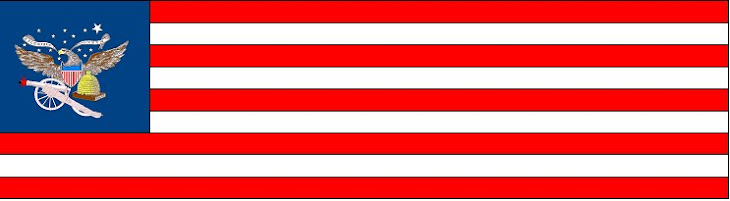
Over the years, the President of the United States has used many different flags. Sometimes there were two versions of the presidential flags displayed during the same period, one for the Army, one for the Navy. The basic design of each incorporated the President's seal that itself was based on the Great Seal of the United States (http://bit.ly/fx45oU). In 1916 President Woodrow Wilson adopted one Presidential flag for use by both the Army and the Navy. On the center of a blue field the flag displayed the President's seal then in use. It differed from the Great Seal in several ways. The constellation of stars of the crest, rather that being shown in a burst of glory, are displayed on rays of glory streaming out from behind the eagle. The bald eagle from the President's seal was depicted with white or silvery feathers, and the bird faced to its own left and the arrows held in the left talons. The bald eagle on the Great Seal has golden brown feathers and faces to its own right and the olive branches of peace. Perhaps Wilson intended this to represent the President's war powers as Commander-in-chief. The President's military position was symbolized on the 1916 flag by four stars, one in each corner. The flags of the top Generals and Admirals at the time also displayed four stars denoting their military rank. Then during World War II, American Four Star Generals appeared to be outranked by European Field Marshalls that existed in allied armies. The rank of Field Marshall did not fit with American military tradition, so Congress created a new rank, General of the Armies and Admiral of the Navy to rank equally with the Field Marshalls. The new rank insignia consisted of five stars. The flags displayed by newly minted Generals of the Army also showed five stars, one more star that included on the Presidential flag. Franklin Roosevelt did not want it to appear as if his top Generals and Admirals out ranked their Commander-in-chief. So, he instructed that a new design, with more stars, be prepared for the President. The new design was not ready until after Roosevelt's death, and so President Harry S. Truman issued a Presidential Proclamation authorizing the new flag. The four stars, one in each corner, were dropped and replaced by a ring of forty-eight stars, one star for each state. With the admission of Alaska and Hawaii the the number of stars in the ring increased to fifty. Does this mean the President is a fifty star General? No, but he is the Commander-in-chief of our National Union of fifty states. But now, the bald eagle is golden brown and faces to the right talons and the olive branch. It is this Presidential flag we see in the Oval Office when the President Obama addresses the nation. It has grown to represent not only the President's miliary authority, but also his role as the leader of the nation.

Sunday, January 2, 2011

A Resolution to Correct the Utah State Flag


In 1922 an unauthorized change made to the design on one Utah State flag altered the pattern used for over eighty years. Numerals for the year 1847, honoring the arrival of the Mormon pioneers, were moved from their original position on the shield appearing at the flag's center to a spot just below the shield. Later flags used the incorrect flag as a pattern. This admittedly small error went unnoticed for about sixty years, until I spotted the discrepancy while examining the flag's legal description contained in the state codes.


The unauthorized change appeared so small, in fact, that it has been regularly overlooked during the flag's long history. This is understandable for casual readings of the description. However, even when more careful scrutiny of wording might be expected, the change went unnoticed.


In November 1933 Utah's Attorney General Joseph Chez responded to an inquiry from the Daughters of the Utah Pioneers. They sent an illustration of the flag asking if it followed the pattern required by law. "I have examined the photograph of the flag enclosed by you, and so far as I am able to determine it meets the specifications of the law" Attorney General Chez assured the women. The article quoting the Attorney General's letter includes a color illustration of the Utah State flag showing the "1847" below the shield.


Some twenty years later the Utah State flag Committee, asked the Attorney General's office for an opinion "whether the design was in conflict with the U.S. flag code" which states "Do not place any object or emblem of any kind on or above the flag of the United States. The committee was concerned that "Utah's flag contains a draped Old Glory surmounted by a spread eagle." This time Assistant Attorney General Walter L. Budge informed the committee that "The Utah state flag is both authentic and in good taste." A newspaper account concludes that "Mr. Budge opined that the restriction [of the flag code] applies only to placing objects on or above the national emblem itself." No mention was made of misplacement of the numbers "1847."


Although I have a thick file of newspaper articles about the Utah State flag, no mention was ever made of the incorrect placement of the numerals below the shield.


After discovering the problem in the 1980s, I shared the information with state officials, historians, reporters and anyone who would listen. This disclosure was often met by a wry smile which seemed to say, "What an interesting piece of trivia."


Early last year, I shared this news with Ron Fox, who did not consider the discrepancy trivial. In respect to the history of the Utah State flag it should be described, illustrated and manufactured correctly. State Representative Julie Fisher agreed and produced a Resolution admonishing flag manufacturers to make the Utah State flag in accordance with State law and the flag's history.


Why does such a small detail matter? Makers of the Utah State flag can only produce flags based on the information they are given. They have obviously made flags based on illustrations following the 1922 flag. The wording of the description adopted in 1913 reflects the original flag and the earliest made Utah State flags. It is a matter of carefully following the Utah Code.


Thursday, September 30, 2010

Twenty-five Americans with Colors Flying


When was the first United States flag displayed in the territory that is now Utah? Many would guess that the pioneers of 1847 carried the first Stars and Stripes into the state. George A. Smith reported that the Pueblo Detachment of the Mormon battalion marched into the Salt Lake Valley on July twenty-ninth in 1847 "carrying the flag of the United States." Within days he continued, the pioneers hoisted the Stars and Stripes over their encampment. Other flag raisings followed. Nevertheless, the first documented display of the U.S. flag took place twenty-two years earlier.

What is now the boundary between Utah and Idaho, was once the border between Mexico and the Oregon territory. Peter Skene Ogden, a fur trapper with the British Hudson's Bay Company, wrote in his journal, "it was not determined between Great Britain and America to whom [the Oregon territory] belonged." In the 1820s both British and American fur companies competed in the area. Each group of trappers claimed the region a part of their country. The area that is now Utah, however, was clearly Mexican land.

During the spring of 1825, both British and American trappers traveled south of the Oregon territory entering Mexican lands. Ogden camped along the Weber River near what is now Mountain Green. On May twenty-third, while fourteen of Ogden's men were absent from camp, "a party of 25 Americans with Colours [sic.] flying" arrived and set up camp about one hundred yards distant from the Hudson's Bay encampment. Here wrote Frederick Merk, they "hoisted the American Flag and proclaimed to all that they were in United State Territories." Ogden recorded that the leader of the American trappers, Johnson Gardner "lost no time informing all hands that they were in United States Territories." Gardner went on to tell the British tappers that they could leave Ogden and join with the Americans. The Americans would pay "3 ½ dollars" per pound in cash for beaver pelts. Ogden's men had debts with the Hudson's Bay Company. Deserting to the American side would give them a fresh start with American companies. Some of Ogden's men deserted and joined with Gardner's group. Ogden had a license from the Mexican to trap in their territory, but Garner continued to insist that the area was U.S. territory. Outnumbered and having lost some of his men, Ogden withdrew.

From this incident, the location became known a "Deserter's Point." The story gives us the earliest document display of the United States flag in Utah. What did the flag look like that Garner and his party carried into camp and defiantly raised? The official United State flag from 1822 to 1836 displayed twenty-six stars. However, the American flag documented may have also been a "trade flag." Trappers often included trade flags in their stores. These flags often included an American eagle in the blue field.

Sunday, September 19, 2010

“The Stars and Stripes are nailed to the North Pole”


It is an old tradition for explorers to plant flags. In 1492 Columbus planted Spain's flag thus establishing a pattern in the New World. Spanish, French, British and American explorers carried flags on their expeditions. Over four centuries after Columbus, Apollo 11's crew planted the United States flag on the moon. Two twentieth century polar explorers, also following this practice of "planting" the U.S. flag. Robert Peary carried the flag during journeys deep into Arctic regions, and almost two decades later Richard Byrd also carried the flag during a flight over the South Pole. Interestingly, the claims of both polar explores drew skeptics. Also interestingly, both men displayed the Stars and Stripes in somewhat unorthodox ways. While both men intended to honor the flag of their country, their handling of Old Glory may seem curious today. Some might even consider their display of the flag desecration. Yet, it should be remembered that the U.S. Flag Code was first created in 1923, and it was not until 1942 that the Federal Government adopted it.
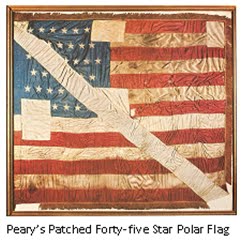
In 1898 Peary's wife made a forty-five star United States flag for her explorer husband. The forty-five star flag was the one adopted when Utah became a state. On Peary's several arctic expeditions, he often carried the flag wrapped around his body under the top layer of his clothing. Reaching objectives he would break out the flag, "planting" the flag at locations all over the far North. Actually, his idea of planting the flag was quite literal. He would then cut a rectangular piece from the flag and "cache" it at the site. Upon his return from each expedition his wife would inset a piece of white material to replace the "cached" part of the flag. At lectures he displayed his flag to dramatize his Peary's Patched Forty-five Star Polar Flag exploits. In poetic words he announced to the world in 1909 that he had reached the North Pole, "The Stars and Stripes are nailed to the Pole."

At a 1910 Hudson-Fulton Celebration in Elmira, New York, Peary's "North Pole" flag drew the unwanted attention of an attorney named Roswell R. Moss. He filed a legal action charging Peary with flag desecration. Peary's lawyer filed a demurrer maintaining that the law cited was unconstitutional. A demurrer is a legal term for a challenge to the form of the charging document. It does not consider the merits of the case. The court sustained Peary's position and dismissed the charge.

In 1954, Peary's widow presented the flag to the National Geographic Society. Today, the patched flag is preserved as a treasured historic artifact.

Richard E. Byrd reported that he and Floyd Bennett flew over the North Pole in 1926. Three years later, after Bennett's death, Byrd flew over the South Pole. With him he had carried a stone taken from Bennett's grave. He tied the stone to an U.S. flag and dropped stone and flag from the plane as he flew over the South Pole. The thus weighted flag fluttered down and was "planted" in the ice and snow below.

These two examples may appear to be strange attempts to honor the flag. They certainly don't seem to follow the rules of the United States Flag Code. However, the Flag Code states in summary, "No disrespect should be shown to the flag of the United States of America . . . ." Certainly, neither man intended any disrespect for the flag. Rather, both explorers made the Stars and Stripes a part of their proudest accomplishments. The flag was important to them. They carried U.S. flags with them and "planted" them in the Polar Regions of the globe.

Friday, August 20, 2010

The Lineage of the Stars and Stripes


Some assume that because of our revolutionary past, that the Stars and Stripes sprang into existence on June fourteenth of seventeen seventy-seven, almost an act of spontaneous generation. Nevertheless, the flag of the United States has a lineage that stretches back to European roots. Like all genealogies, it has some lines of descent that are proven by the historical record. Some lines are less certain when records are incomplete or missing. Some purported pedigrees may be based on false claims resting on coincidence rather than relationship. Finally, some ancestry remains undiscovered.
As with the thirteen original colonies, the flag's parentage rests with Britain. They saw England in a very real sense as the mother country. The United States flag inherited at least three things from this parentage. First, the national colors of red, white and blue. Second, a flag divided into two parts: a field and a canton or union. Third, the very idea that the flag symbolizes a political union.
"What do the colors signify?" Congress apparently gave no thought to the meaning of the colors when the flag was first adopted. Red, white and blue were simply inherited from the British flag that came before. Where, we may ask, did these colors originate in their British use? The colors came from the flags of England and Scotland.
England's flag of St. George is a red cross on a white field. By legend Saint George, England's patron saint, slew a dragon to save a maiden. George carried the white shield of purity and innocence. Dipping his lance into the dragon's blood, he outlined a red cross on his shield. English medieval soldiers wore St. George's cross front and back to identify them in battle. Thus red and white come from England.
Scotland's Cross of St. Andrew also supplied two colors: blue and white. Saint Andrew suffered crucifixion on an X-shaped cross, know in heraldry as a saltire. Seeking divine intervention in battle, the ancient Scots beheld an X-shaped formation of white clouds against a blue sky. Victorious, they adopted this sign as their emblem. Thus Blue and white come from Scotland.
In 1603 England's virgin queen, Elizabeth I, died and King James VI of Scotland inherited the British throne. At the beginning of his reign, each of his two kingdoms flew their own flags. St. George's cross in England and St. Andrew's cross in Scotland. Conflict arose at sea. Sailors from each realm competed to fly their own flag in preference to the other. To end the conflict, the king's heralds designed one flag to symbolize both nations. They simply superimposed the cross of St. George over the cross of St. Andrew. This formed the first British Union flag, known familiarly as the Union Jack. This union, however, was the personal union of two kingdoms with one sovereign. Political union of the two realms followed in 1707.
In heraldry, a shield is often divided into four parts or quarters. They are numbered one through four, beginning in the upper left had corner and rotating clockwise around the shield. The first quarter, is considered the most honorable. It is closest to the sword arm of the knight as he would carry the shield. The canton is a named smaller division of the first quarter. Perhaps like the heart of the watermelon, the canton is the best part of the quarter. British nautical flags also made use of the canton. At one time, British ships were identified as being part of the red, white or blue squadrons. Squadrons flew colored ensigns matching their designation. In the canton of each colored flag was placed the cross of St George or the cross of St. Andrew as appropriate for England or Scotland. These gave way to placing the union design in the canton.

By the time of the American Revolution, the British Red Ensign had become the merchant flag of the British Empire. This flag was the most used by the colonists before their break with the mother country. The colors, the canton and the concept of political union symbolized by the Red Ensign furnished the model for the flag of a new nation. Colonists replaced the red field with thirteen red and white stripes. The British Union gave way to a new American union device, thirteen white stars on a blue field, a new constellation. Just as a constellation rises in the night sky, the new nation rose to take her place among the nations of the world.

Wednesday, July 28, 2010

O’ Columbia Gem of the Ocean


Famed as the first ship to carry the Stars and Stripes around the globe, the Sailing Ship Columbia Rediviva is commonly known as the Columbia. Indeed in 1773, this merchant ship was christened simply as the Columbia. This designation was and is a poetic nickname for the United States and honors Christopher Columbus. Columbia was rebuilt in 1787 and given the added Latin name Redivivia meaning revived. The ship's full formal name thus translates from Latin roughly as "land of Columbus reborn." There is something symbolic in her full name. The Boston Tea Party took place the same year the Columbia was first launched. The struggle for independence was then beginning. The Revolution ended in 1784 by the Treaty of Paris, and thirteen British colonies had a rebirth as an independent nation. Three years later, Colombia Rediviva departed from Boston carrying the flag of the newly independent United States of America, indeed she lived up to her name Columbia reborn.

The voyage began on September 30th of 1787. From her rigging, Columbia Rediviva flew a flag displaying thirteen stripes and thirteen stars. Her voyage took her around South America to the Pacific coast of the continent where she discovered, named and explored the lower reaches of the Columbia River. Continuing westward across the Pacific, she made her way around the Asian land mass and Africa back to the Atlantic Ocean. Finally returning to Boston in 1790, she had circumnavigated the globe displaying the Stars and Stripes to the world.


What did the U. S. flag look like that was first carried around the world? We don't know exactly. There were many versions of the first Stars and Stripes. The pattern of stars existed in many variations. The stars usually had five points. Nonetheless, stars on flags sometimes boasted six or more points. Even the stripes showed variety. The flag was most often a red field with six white stripes. In this arrangement the top and bottom stripes are red. Still, a white field with six red stripes was not unknown. Then, the top and bottom stripes were white. On occasion, the stripes were even red, white and blue.

A replica of Columbia Rediviva plies the waters of Disneyland's Rivers of America. She flies the version of the thirteen star flag that is best known, today. Usually called the Betsy Ross flag, this flag displays thirteen five-pointed stars in a circle. Common for most of our nation's later history, this version was uncommon during the revolution. Some flag historians have even asserted the ring of thirteen stars was not contemporary to the American Revolution. However, it appears to have been used. Also used occasionally, was a circle of twelve stars with the thirteenth star at the center. More common is a pattern of stars in rows of three, two, three, two and three. Less common but also used, the stars appeared in rows of four, five and four. Any one of these star patterns could have been shown on the flag carried around the world by Columbia Rediviva. Nevertheless, the voyage lasted more than a year and more than one flag was likely used.

Columbia continued under sail until salvaged in 1806. Yet, she still served as inspiration for the nation. Three U.S. Navy vessels have been named for the Sailing Ship Columbia. Disneyland in 1956 launched a replica of Columbia to honor the vessel. In 1969, the Apollo 11 command module for the first lunar landing bore the name Columbia. The space shuttle Columbia became the world's first reusable space craft flying space missions beginning in 1981. Tragically, she and her seven astronaut crew perished on reentry in 2003. Only Disneyland's Columbia continues in service having sailed the waters of Frontierland for over fifty-four years.

In 1843, Columbia Gem of the Ocean appeared as a patriotic song that still inspires Americans. The song missed being selected in 1931 as our national anthem. It was beat out by another song with a flag connection, the Star Spangled Banner. In the song Columbia the Gem of the Ocean, its name serves as a metaphor for the nation or ship of state. Still, the song concludes with words that must echo shouts that greeted Columbia Rediviva on her return from circumnavigating the globe, "Three cheers for the red, white, and blue."